Annotation
- Introduction
- Model Architecture and Availability
- Performance and Capabilities
- Technical Innovations
- Pros and Cons
- Conclusion
- Frequently Asked Questions
DeepSeek-V3.2 AI Models: Advanced Reasoning and Agent Performance Released
DeepSeek releases V3.2 and V3.2-Speciale AI models, enhancing reasoning for agent applications with advanced performance in math and programming contests and innovative training methods.
Introduction
DeepSeek has unveiled its V3.2 and V3.2-Speciale models, marking a significant advancement in AI reasoning capabilities. These new releases specifically target enhanced performance for autonomous agent applications, offering distinct deployment options for different user needs. The development represents a strategic move in the competitive landscape of AI chatbots and reasoning-focused systems.
Model Architecture and Availability
The standard V3.2 model is broadly accessible through multiple channels including mobile applications, web interfaces, and API endpoints. This wide availability makes it suitable for general-purpose integration across various platforms. Meanwhile, the V3.2-Speciale variant offers specialized optimization for complex reasoning tasks, though it remains limited to API access only. This tiered approach allows developers to choose the appropriate model based on their specific requirements for AI APIs and SDKs.
Performance and Capabilities
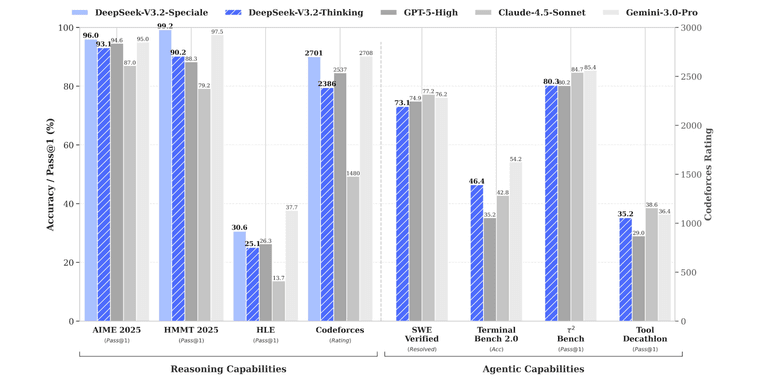
Initial benchmarks indicate that the V3.2-Speciale model matches or exceeds the performance of leading competitors in global mathematics and programming competitions. This achievement demonstrates substantial progress in logical reasoning and problem-solving capabilities. The models introduce a novel large-scale agent training methodology that directly integrates reasoning processes into tool-use workflows, creating more efficient AI agents and assistants.
Technical Innovations
DeepSeek's approach focuses on enhancing the fundamental reasoning architecture rather than simply scaling parameter counts. The new training methodology emphasizes contextual understanding and step-by-step problem decomposition, which proves particularly valuable for complex analytical tasks. This development represents important progress in the field of AI automation platforms and intelligent systems.
Pros and Cons
Advantages
- Superior performance in mathematical and programming competitions
- Dual-model strategy for different use cases and budgets
- Advanced reasoning capabilities for complex problem-solving
- Direct integration of reasoning with tool-use workflows
- Broad accessibility through multiple deployment channels
- Innovative large-scale agent training methodology
Disadvantages
- Specialized model limited to API access only
- Potential computational resource requirements
- Limited real-world testing data available currently
Conclusion
The DeepSeek-V3.2 release represents a meaningful advancement in AI reasoning technology, particularly for applications requiring sophisticated problem-solving capabilities. The dual-model approach provides flexibility for different implementation scenarios while maintaining competitive performance. As these models become more widely adopted, they may influence development standards across the broader conversational AI tools ecosystem and establish new benchmarks for reasoning-focused artificial intelligence systems.
Frequently Asked Questions
What is the difference between DeepSeek-V3.2 and V3.2-Speciale?
The standard V3.2 model is broadly available through apps, web, and API, while V3.2-Speciale is optimized for complex reasoning tasks and limited to API access only, offering superior performance in mathematical and programming competitions.
How does DeepSeek-V3.2 perform compared to competitors?
Benchmarks show that DeepSeek-V3.2-Speciale matches or exceeds leading competitors in global math and programming contests, demonstrating advanced reasoning capabilities and problem-solving performance.
What are the deployment channels for DeepSeek-V3.2?
The standard V3.2 model is available through mobile apps, web interfaces, and APIs, while V3.2-Speciale is limited to API access for specialized reasoning tasks.
How does the large-scale agent training methodology work?
It integrates reasoning processes directly into tool-use workflows, enhancing efficiency and problem-solving capabilities for AI agents through contextual understanding and step-by-step decomposition.
What are the potential use cases for these AI models?
Applications include autonomous agents, complex reasoning tasks, programming assistance, mathematical problem-solving, and advanced AI automation in various industries.
Relevant AI & Tech Trends articles
Stay up-to-date with the latest insights, tools, and innovations shaping the future of AI and technology.
Stoat Chat App: Complete Guide to Revolt Rebranding and Features
Stoat chat app rebranded from Revolt due to legal pressures, maintaining all user data, features, and privacy focus without any required actions from existing users for a seamless transition.
Zorin OS 18: Modern Linux OS with Windows App Support & New Features
Zorin OS 18 is a Linux distribution with a redesigned desktop, enhanced Windows app support, and web apps tool, ideal as a Windows 10 alternative with long-term support until 2029.
AV Linux 25 & MX Moksha 25 Released with Enhanced File Manager & VM Features
AV Linux 25 and MX Moksha 25 are new Linux releases based on Debian Trixie, featuring enhanced file management with Quickemu and YT-DLP integration, tailored for multimedia production and lightweight computing.